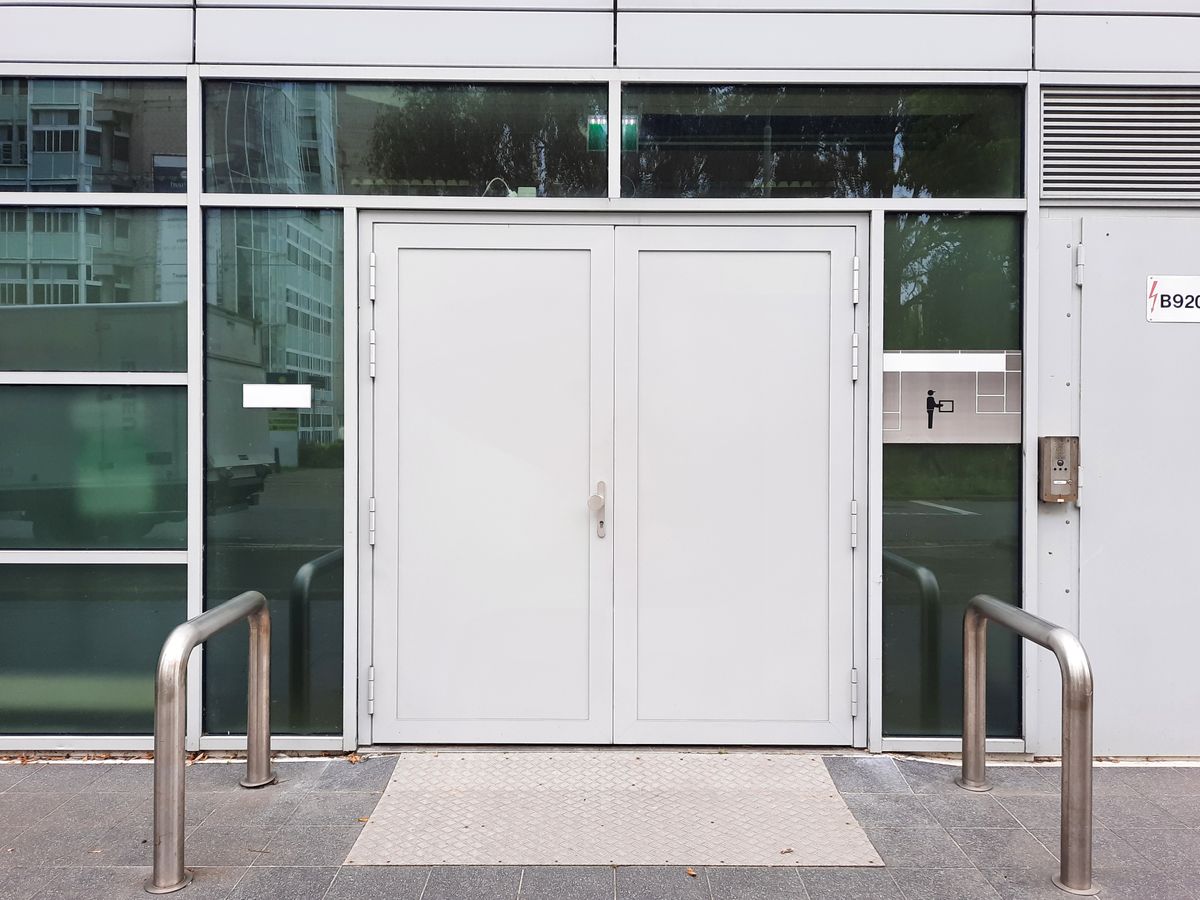
Short answer: repair compatible hardware when the door and frame are sound and the cause is understood. Investigate the whole assembly when faults recur, and compare replacement when the door, frame or several components are deteriorated. Treat exit, fire-rated, powered and accessibility-related problems as specialist assessment priorities, not routine hardware swaps.
A property manager with several offices in Buckhead, Sandy Springs or Marietta may receive ten tickets that all say “door not closing.” One might involve an ordinary interior handle, another a damaged threshold, and another a required exit. Combining them into a single list helps procurement, but assigning the same repair to all ten can create avoidable repeat visits and safety risks.
Start with a door inventory, not a shopping list
Assign each opening a stable identifier, such as building, floor and door number. Record its purpose: public entrance, ordinary office door, service corridor, restroom or required exit. Ask the building manager to identify known fire ratings, access control and accessibility functions. If its function is unclear, mark it for review rather than assuming it is an ordinary door.
Collect a wide view of the opening and surrounding floor, both faces where authorized, and close views of visible hardware, damage and manufacturer markings. Keep security-sensitive details private. Record what users experience: rubbing, failure to close, excessive resistance, repeated slamming or failure to latch. Note whether the problem occurs all day or only during changes in weather or building operation.


A symptom report is not a diagnosis. A door that rubs near the floor may be affected by the door, frame, threshold or recent flooring work. An entrance that becomes harder to operate at certain times may warrant an evaluation of pressure or weather conditions. Avoid filing, drilling, removing devices or adjusting an unidentified rated assembly based only on a photograph.
Four findings that lead to different scopes
01 · Hardware fault
Finding: Loose ordinary handle, worn component or inconsistent closing on an otherwise sound opening.
Next step: Identify the exact compatible hardware and the cause before ordering.
02 · Door or frame fault
Finding: Repeated rubbing, visible distortion, corrosion, damaged attachment points or loose frame.
Next step: Assess the assembly and supporting construction; a new lock may not solve it.
03 · System or safety fault
Finding: Exit does not operate as required, suspected fire-door defect, access-control failure or accessibility concern.
Next step: Escalate to the responsible facility team and qualified specialist; do not bypass safeguards.
04 · Replacement candidate
Finding: Multiple failing components, extensive physical damage or obsolete compatible parts.
Next step: Compare a complete specified assembly against a durable, compatible repair.
For a sound non-rated opening with a localized fault, a properly specified component repair may avoid needless demolition. A frame that has shifted or a badly damaged door is different: even new hardware may be loaded incorrectly. Ask for a written explanation of the proposed repair and what will be checked after installation. If there are signs of structural movement, involve an appropriate structural professional before proceeding.
Separate safety-critical doors from routine maintenance
Under OSHA's workplace exit-route requirements, employees generally must be able to open exit-route doors from inside without keys, tools or special knowledge. Certain protected exit openings require listed or approved fire-door assemblies. OSHA's maintenance requirements also address unobstructed routes and working emergency safeguards. Report a compromised required exit immediately to the responsible facility team; follow the site's emergency procedures and obtain qualified assistance.
For openings subject to the ADA Standards, the U.S. Access Board's door guide explains operating hardware, clear width, maneuvering space, thresholds, closing speed and opening force. Its five-pound maximum opening force for accessible interior hinged doors has exceptions, including fire doors and exterior hinged doors. Do not use that number as a universal adjustment target. The applicable requirements depend on the building and opening.
Have qualified door, fire-protection or access-control specialists evaluate regulated assemblies, and qualified electrical, HVAC or structural professionals handle their respective systems where needed. Never disable exit hardware, door closers, alarms or required latching to make a ticket disappear. Coordinate applicable permits and building approvals with the authority having jurisdiction. This article is a planning aid, not a code compliance inspection.
Turn your survey into an estimate that can be compared
Group ordinary repairs by hardware compatibility, site access and scheduling window, while keeping specialist work separate. Ask whether the estimate includes diagnosis, parts, installation, adjustments, disposal and final functional checks. Distinguish the price of one component from a complete installed opening: replacement can also involve frames, adjacent finishes, glass, access-control coordination and temporary access arrangements.
Example work-order map · fictional openings
Ordinary interior door, loose handle. Confirm sound assembly and compatible hardware.
Repeated rubbing after earlier hardware repair. Document frame and floor conditions before ordering parts.
Reported failure to operate as required. Alert facility management and arrange qualified assessment; do not treat as a routine ticket.
- Opening ID, purpose, reported symptom and photo reference.
- Known rating, accessibility or access-control requirements; unknowns requiring investigation.
- Compatible part specification or proposed assembly replacement, with exclusions.
- Access window, authorized site contact and plan to maintain required routes during work.
- Post-work functional verification, specialist sign-off where needed and updated maintenance record.
For repeat failures, compare the total likely cost of recurring visits and downtime against a durable repair or replacement, without assuming a new door always pays for itself. Coordinate adjacent flooring, wall finishing and door and hardware work so the completed opening is not damaged by subsequent trades. Our commercial work-order guide helps organize these dependencies.
Frequently asked questions
Why does the same commercial door keep failing after hardware replacement?
The original cause may be misalignment, frame movement, a damaged mounting surface, pressure differences or hardware incompatible with the door. Document repeat failures and request an assembly-level assessment instead of another identical part.
Can a door closer simply be adjusted to make a heavy door easier to open?
Not always. Closing behavior and opening force have different requirements. Door weight, seals, wind, air pressure, fire rating and closer compatibility may matter. Have the appropriate specialist evaluate the opening without compromising latching or safety.
Do we need to replace an entire commercial door when the lock fails?
Not necessarily. If the assembly is sound and compatible replacement hardware is available, component repair may be suitable. The fire rating, exit function, accessibility and access-control requirements must be respected.
Can several locations use the same replacement hardware?
Only after confirming their door types, dimensions, functions, ratings and manufacturer compatibility. A standardized inventory can simplify purchasing, but identical-looking openings may have different requirements.
What should I send before requesting a multi-door estimate?
Provide the site and door IDs, photos of the assemblies and visible manufacturer labels, reported symptoms, previous repairs, operating hours, and any known rated, exit or access-control functions. Send sensitive security details only through an approved private channel.